
The Capitec credit card charges R0 per month. Zero. That number appears in Capitec's own fee schedule for self-service users, yet almost every review online still quotes "around R50" as the monthly cost.
That disconnect tells you something about how most guides approach this card. They copy old fee tables, skip the fine print, and miss the one detail that changes the math for digital-first applicants.
This guide is for South Africans earning between R5,000 and R15,000 per month who want a first or second credit card without paying for the privilege of holding it. If you manage everything through the Capitec app, the cost structure looks different from what most comparison sites describe.
The R0 Monthly Fee and Its Asterisk
Capitec's credit card fee schedule, updated March 2026, lists the monthly service fee as R0 when all transactions and management happen through self-service channels.
That means the app, ATMs, and online banking. The moment you walk into a branch and ask a consultant to process something, fees apply.
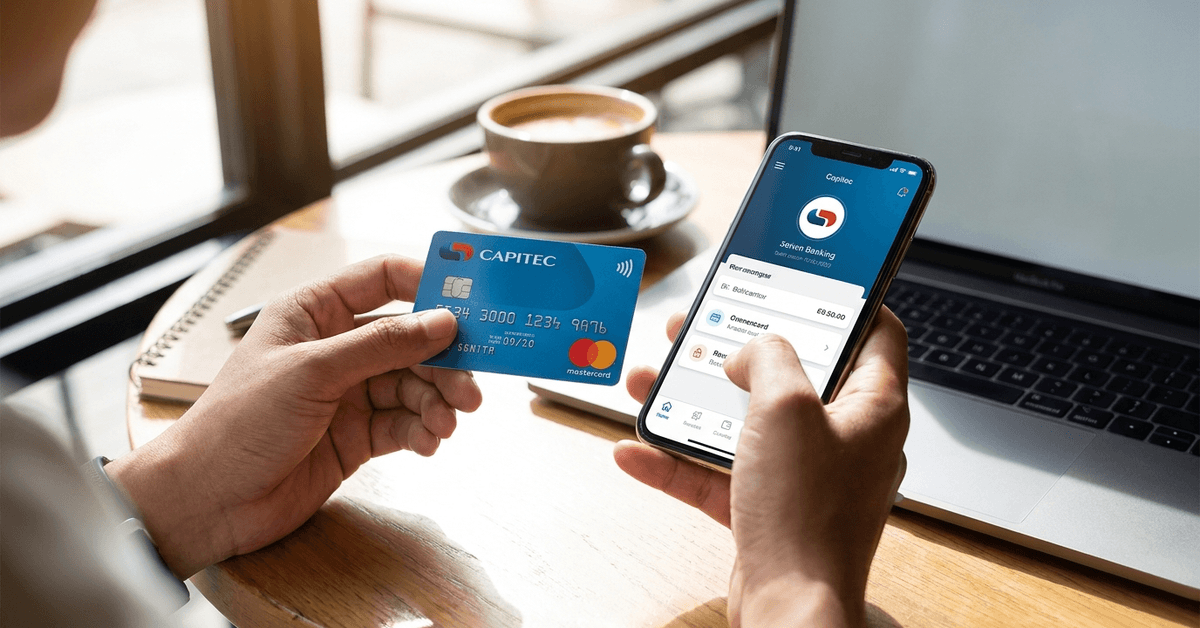
This matters because the R0 figure isn't a promotional rate or a limited-time waiver. It is the standard pricing for anyone who never touches a branch counter for credit card transactions.
Most South African bank credit cards charge between R40 and R100 per month just to exist in your wallet.
Why the Fee Difference Gets Buried
I think the confusion around Capitec's R0 fee comes from the fact that their Global One transactional account carries its own service fee of R5 per month.
Reviewers blend the two products together and land on numbers like R40 or R50, which may reflect older pricing or bundled account costs.
The credit card and the transactional account are separate products. A Capitec Global One account is required to hold the credit card, but the credit card's own monthly charge stays at R0 for self-service users.
Capitec Credit Card Interest Rates for 2026
Interest rates on this card are not fixed by tier. Capitec assigns a personalized interest rate based on your individual credit profile, and the range sits between roughly 11.75% and 22.25% per annum.
The National Credit Act caps credit facility interest at 24.85% per year in 2026, so Capitec's upper end still falls below the legal ceiling. That personalized approach is a real split from how FNB, Standard Bank, or Nedbank structure their cards.
Those banks assign rates by card tier: gold gets one rate, platinum gets another. Capitec ignores the tier system entirely and prices you based on your credit score and affordability assessment.
Does the Interest Rate Even Matter?
I would argue that obsessing over interest rates when picking a credit card is the wrong move for anyone earning under R15,000 per month.
If you carry a monthly balance on a credit card at any rate above 10%, the interest cost will erase any cash-back or reward benefit the card offers. The 55-day interest-free window on the Capitec card makes the interest rate irrelevant for disciplined users who clear the balance each cycle.
A card with a 22% rate and R0 monthly fee costs less over 12 months than a card with an 18% rate and a R75 monthly fee, assuming the holder pays in full every month. The monthly fee is guaranteed. The interest charge is optional.
How to Apply for a Capitec Credit Card in 2026
The application runs entirely through the Capitec app or website. No branch visit is necessary for the application itself, though you can visit one if you prefer.
Eligibility comes down to a few hard requirements:
- Minimum monthly income of R5,000 (R10,000 for self-employed applicants)
- South African ID document or valid permit for foreign nationals
- An existing Capitec Global One account, or willingness to open one during the process
- No active debt review or sequestration
The Instant Decision and Its Limits
Capitec advertises instant decisions through the app, and most applicants do get a result within minutes. The app runs a credit assessment, generates a personalized interest rate, and presents a credit limit offer on the spot.
But "instant" has a catch. If your income verification doesn't match Capitec's internal records, you may need to upload payslips or three months of bank statements manually.
That pushes the timeline to 48 hours or more. Self-employed applicants almost always hit this delay.
Documents to Have Ready
Even though the app tries to pull your information automatically, keeping these accessible will speed things up:
- Latest payslip or proof of income
- Three months of bank statements (especially if you're not an existing Capitec client)
- Proof of residential address dated within the last three months
University students can also apply by submitting an enrolment letter alongside their application. Capitec doesn't widely advertise this option, but it appears on their official credit card page.
Capitec Credit Card Fees vs Other SA Banks
The fee comparison across South African banks shifted in 2026. Capitec's R0 self-service fee puts it in a category that most traditional banks don't compete in directly.
| Feature | Capitec Credit Card | Standard Bank Blue | FNB Gold Credit Card |
|---|---|---|---|
| Monthly fee | R0 (self-service) | ~R42/month | ~R65/month |
| Interest-free period | Up to 55 days | Up to 57 days | Up to 55 days |
| Interest rate range | 11.75% - 22.25% | Personalized | Personalized |
| Cash back | Yes (on purchases) | Via UCount rewards | Via eBucks |
| Credit life insurance | Included free | Varies | Varies |
Standard Bank's Blue card wins on the interest-free window by two days. But the monthly fee difference of R42 adds up to R504 per year. That gap buys a lot of patience for two fewer interest-free days.
Who the Capitec Credit Card Quietly Fails
Not every applicant will love this card. The product has specific blind spots that the "best credit card in SA" rankings tend to skip.
- Frequent international travelers will notice that Capitec's international transaction processing fees apply to every cross-border purchase. The bank charges a percentage-based fee on foreign currency transactions, and supplementary cards cannot be used internationally at all. Someone taking four international trips a year would save money with a dedicated travel card from Discovery or FNB.
- High-income earners looking for premium perks will find the rewards thin. Capitec does offer free airport lounge access and dining vouchers for credit card holders, but the earn rate on cash back doesn't compete with FNB's eBucks system or Discovery Miles for people spending R30,000+ per month.
- Branch-dependent users lose the R0 fee advantage immediately. If you regularly visit a branch for credit card queries or transactions, the fee structure shifts, and the cost advantage over competitors shrinks.
The Credit Limit Question
Capitec offers credit limits up to R500,000, but first-time applicants rarely see anything close to that number. Initial limits tend to be conservative, often between R5,000 and R20,000, depending on income and credit history.
The limit increases over time based on repayment behavior. Capitec's app allows you to request a credit limit review directly, and the bank runs a fresh affordability assessment each time.
I think the conservative initial limit is a feature, not a flaw, for first-time credit card users earning under R15,000 per month. A R50,000 limit on a R8,000 salary is a debt trap waiting to snap shut.
Smart Moves After Approval
The card's value depends on how it is used after activation. A few habits separate the users who benefit from those who regret applying.
- Set up autopay for the full balance through the Capitec app, not the minimum payment. The 55-day interest-free period only works if the previous cycle's balance hits zero.
- Turn on real-time transaction notifications. Capitec's app sends instant alerts for every swipe, tap, or online purchase. Unrecognized charges get caught in minutes instead of days.
- Avoid cash withdrawals on the credit card. Interest on cash advances starts immediately with no grace period, and ATM withdrawal fees stack on top.
- Check the app for temporary promotions. Capitec periodically runs cash-back bonuses or data rewards through Capitec Connect that only appear inside the app.
Questions People Ask About the Capitec Credit Card
These are the questions I see popping up most often in South African finance forums and search results.
- Q: Can I get a Capitec credit card if I'm blacklisted?
A blacklisted credit record doesn't automatically disqualify an applicant, but it does affect the credit limit and interest rate offered. Capitec runs a full credit assessment, and applicants under debt review or sequestration will be declined. A poor credit history might still result in approval, just with a very low limit. - Q: How long does Capitec take to deliver the physical card?
After approval, the card gets couriered to your address or prepared for branch collection. Delivery typically takes 3 to 7 business days. The app generates a virtual card number immediately after approval, so online purchases can start before the physical card arrives. - Q: Does the Capitec credit card include travel insurance?
Capitec includes free basic travel insurance when flights are booked using the credit card. Coverage goes up to R5 million depending on the policy terms. Check the specific insurance schedule on Capitec's website, as coverage details and claim procedures differ from traditional standalone travel insurance.
Conclusion
The Capitec credit card earns its spot as a low-cost entry point for South African earners who bank digitally. The R0 self-service fee changes the math that most comparison sites get wrong about this product.
Pair it with a dedicated travel card if international spending is part of your life. Check Capitec's 2026 fee schedule directly, because the numbers on third-party review sites are almost always outdated.