
A household with four or more children in Uruguay can receive up to $10,410 pesos per month through the Tarjeta Uruguay Social. That figure is the duplicated amount for 2026, loaded onto a prepaid BROU card every 30 days.
Most guides about the TUS focus on documents and office addresses. Almost none explain the scoring system that decides if a family qualifies, how much they get, or why one household receives double what another does.
This article is for Uruguayan families earning very little who suspect they qualify but have no idea what MIDES measures during a home visit. Knowing the formula changes everything about how the process works.
The ICC Score Decides Everything, and Almost Nobody Explains It
The Tarjeta Uruguay Social goes to roughly the 60,000 lowest-income households in Uruguay. MIDES calls this group the "primer veintil," the bottom 5% by per-capita income. But income alone does not decide who gets in.
The tool MIDES uses is the Índice de Carencias Críticas, or ICC.
Created in 2008 through a partnership between MIDES and the Universidad de la República, the ICC assigns every applicant household a score between 0 and 1. A score of 1 means maximum deprivation.
What the ICC Measures During a Home Visit
The ICC looks at structural conditions that are hard to fake or manipulate. Think education levels of household members, housing quality, access to basic comforts, and household composition. MIDES designed it this way on purpose.
An applicant's paycheck matters. But so does the material of their walls, whether children in the home attend school, and how many people share the same roof. The ICC combines and weights all of these into a single number.
I think this design creates a blind spot for families who earn almost nothing from informal work but live in a relative's concrete house.
Why a Low Income Does Not Guarantee Approval
A common mistake is assuming that poverty equals automatic eligibility. MIDES is measuring structural vulnerability, not temporary hardship.
Someone who just lost a job but lives in a well-built home with educated adults may not score high enough on the ICC.
This distinction matters because the system targets chronic deprivation. A household in a temporary financial crisis can request a Canasta de Emergencia through MIDES instead, which is a one-time food aid for non-TUS recipients.
TUS Simple vs TUS Doble: the Split That Sets Payment Amounts
The 60,000 qualifying households are split into two tiers. The bottom 30,000 with the worst ICC scores receive the monto duplicado (double amount). The next 30,000 receive the monto simple. Same card, same stores, very different monthly totals.
2026 Monthly Amounts by Household Size
Here is what MIDES loads onto the card each month as of January 2026:
| Household Type | Monto Simple | Monto Duplicado |
|---|---|---|
| 0 or 1 minor | $1,935 | $3,870 |
| 2 minors | $2,936 | $5,871 |
| 3 minors | $3,734 | $7,468 |
| 4+ minors | $5,205 | $10,410 |
The amounts are capped at 4 minors. A household with 6 children receives the same base as one with 4. But additional stipends for pregnant women and children under age 3 are added per person without a cap.
Bono Crianza and Other Add-Ons for 2026
The government announced a 50% increase in the Bono Crianza for TUS Doble households starting January 2026. That raised the monthly stipend to $3,339 per beneficiary for families with children under 4 or pregnant members.
TUS Simple households got a 25% bump, bringing their Bono Crianza to $2,783 per beneficiary. A second increase to 50% is planned for 2028.
A new benefit called the Canasta Higiénica Menstrual launched in 2026 too. It pays 1,200 pesos per year, split into monthly payments, for people between ages 12 and 50 in TUS Doble households. The first phase covers roughly 82,000 beneficiaries.
Other active add-ons include:
- PAEC (Programa de Apoyo a Enfermos Crónicos): $1,177 monthly for household members with chronic illnesses certified by a doctor. Requires a medical certificate renewed every 3 months.
- Bienvenido Bebé: $1,177 monthly for babies under one year born at specific public hospitals (Pereira Rossell, Hospital de Clínicas, Bella Unión, Artigas, Rivera).
- Bono de la Leche: $470 monthly per eligible child, increased from $447 in the prior year.
How to Request the Tarjeta Uruguay Social in 2026
The process starts at a MIDES Oficina Territorial. There is no fully online application. A household member over 18 must visit in person with a valid cédula de identidad in good condition.
I'd push back on the advice that gathering a stack of documents should be the first step. The initial visit is a declaration, not a document dump.
MIDES asks the applicant questions about household composition, education, work history, and nominal income. That information feeds the ICC calculation.
The Home Visit Step
After the office declaration, MIDES sends a technical team to visit the household. This visit is where the ICC score gets built. The team applies a standardized questionnaire and observes living conditions.
The timeline between declaration and visit varies. Some households wait weeks, others longer. Demand and regional office capacity play a role. Calling the free MIDES line at 0800 7263 (Monday to Friday, 9 to 17) is the fastest way to check status.
Documents to Bring for Specific Cases
The cédula is the only universal requirement for the initial declaration. But specific situations trigger extra paperwork:
- Pregnant applicants: carné obstétrico showing the estimated due date
- Minors living with non-parents: judicial custody order or mediation agreement from the courts
- Public sector employees in the household: a certificate confirming they do not already receive Asignación Familiar through their employer
- Pregnant minors: an additional report from MIDES itself
Where the Card Works and How Deposits Land
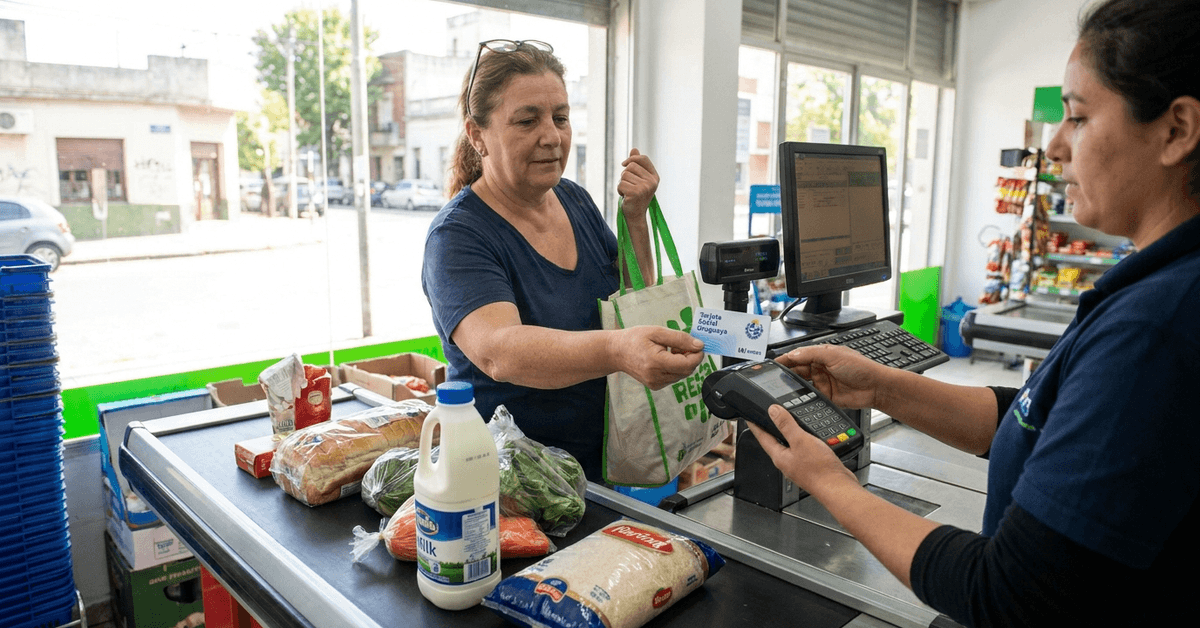
The TUS is a prepaid magnetic card issued through BROU. It cannot be used to withdraw cash from ATMs. All purchases happen through the Red de Comercios Solidarios, a network of over 5,000 stores across Uruguay.
Purchases made with the TUS are exempt from IVA (value-added tax). That effectively stretches each peso further than a cash purchase at the same store.
Deposit Dates by Cédula Number
MIDES loads funds based on the last digit of the cardholder's cédula (excluding the verification digit after the dash):
- Digits 1-2: deposited on the 10th
- Digits 3-4: deposited on the 12th
- Digits 5-6: deposited on the 14th
- Digits 7-8: deposited on the 16th
- Digits 9-0: deposited on the 18th
Rural families living 10 kilometers or more from the nearest Comercio Solidario receive an additional transport stipend. The amount is calculated by multiplying the official per-kilometer bus fare by the round-trip distance to the closest store.
Eligible Product Categories
The card covers food, personal hygiene products, household cleaning supplies, clothing, and supergás (cooking gas). There is no minimum purchase amount.
It does not cover alcohol, tobacco, electronics, or anything outside those five categories. Store terminals are programmed to reject ineligible items.
Questions People Ask About the Tarjeta Uruguay Social
These are the most searched questions about the TUS that I see coming up consistently.
- Q: Can I apply for the TUS online in 2026?
There is no full online application. The process requires an in-person visit to a MIDES Oficina Territorial. Some pre-registration steps may be available through the MIDES website, but the ICC evaluation requires a physical home visit and a face-to-face declaration. - Q: Is the Tarjeta Uruguay Social considered taxable income?
No. The TUS is classified as a social benefit and does not need to be declared on personal tax filings. If a household has unusual financial circumstances, confirming with a local accountant or calling BPS can clear up questions. - Q: What happens if my TUS card is lost or stops working?
A replacement card can be requested at any MIDES Oficina Territorial. Bring a valid cédula. Calling 0800 7263 first to report the issue speeds up the replacement process and protects the remaining balance.
Conclusion
The Tarjeta Uruguay Social in 2026 reaches roughly 140,000 households across both simple and double tiers.
The ICC score, not income alone, determines eligibility and the payment amount a family receives monthly.
Gathering documents matters less than understanding what MIDES evaluates during the home visit. Start at your nearest Oficina Territorial with a valid cédula and let the process move from there.