A student visa holder working 28 hours per week at Japan's national average minimum wage of ¥1,121/hour takes home roughly ¥125,000 per month. Average monthly expenses for an international student in Japan sit around ¥170,000.
Sukiya, the largest gyudon chain in Japan with nearly 2,000 domestic locations, hires roughly 50,000 crew members. Most of those positions are part-time arubaito roles designed for exactly the kind of schedule a student needs.
This breakdown is built for international students already in Japan or planning to arrive on a student visa, specifically those weighing Sukiya against other food service options like Matsuya, Yoshinoya, or convenience store chains.
What a Shift at Sukiya Feels Like in Practice
The daily routine at a Sukiya branch blends counter service, food preparation, cleaning, and register work into a single role. Crew members are cross-trained on everything.
There is no "I only do the register" option. The expectation from day one is that each person rotates through all stations during a shift.
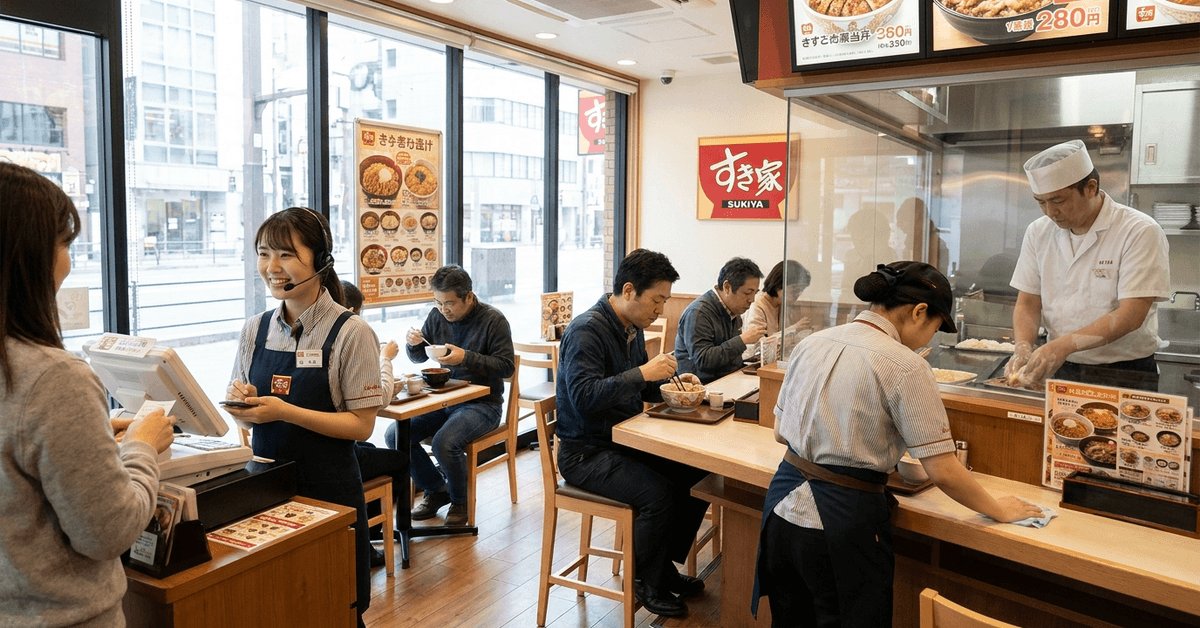
That rotation setup matters more than most job descriptions let on, because Sukiya uses self-order tablets and self-checkout machines in many branches. Cash handling is minimal.
The customer-facing part of the job has gotten simpler over the past few years, which shifts the real workload toward food prep, dishwashing, and restocking.
Counter, Kitchen, and Cleaning Rolled Into One
A typical shift involves assembling gyudon bowls from pre-portioned ingredients, greeting customers, explaining the menu to confused first-timers, running the register when self-checkout fails, wiping down tables, restocking napkins and condiments, and dealing with the occasional complaint about order accuracy.
The pace picks up hard during lunch rush. Sukiya branches often run with a skeleton crew of two or three people, so there is nowhere to hide during peak hours.
My take on Sukiya's 2-person midnight shift policy is that it protects safety but creates a workload that surprises people who expected a quiet late-night gig.
Part-Time vs Full-Time Sukiya Positions Compared
The split between part-time and full-time at Sukiya isn't just about hours. Benefits, pay structure, and scheduling expectations differ in ways that affect your take-home pay and your visa status.
Part-time crew members set their own availability within the branch's operating hours. Shifts can run as short as 2 hours, and the minimum commitment is 2 days per week.
Full-time contract staff, especially in the deep-night category, work fixed 8-hour shifts between 22:00 and 09:00 with a starting annual salary above ¥3,000,000.
Pay and Benefits at a Glance
The biggest takeaway: part-time workers who stay under 20 hours per week avoid social insurance enrollment, which means no automatic pension deductions.
For a student capped at 28 hours, that threshold sits right in the middle of your available range.
| Feature | Part-Time (Arubaito) | Full-Time (Contract/Seishain) |
|---|---|---|
| Hourly Rate | ~¥1,100–¥1,500 depending on region and shift | Salaried (~¥3M+/year for night contract roles) |
| Shift Length | 2–6 hours, flexible | 8 hours, fixed schedule |
| Meal Discount | Available after 1+ hour shift | Available |
| Social Insurance | Only if working 20+ hrs/week | Full coverage (health, pension, unemployment) |
| Bonus | None | Twice yearly for contract and full employees |
| Rank Advancement | New Face → Crew → Captain → Chief | Manager track with formal training |
Who Should Pick Part-Time, and Who Should Go Full-Time
Part-time Sukiya work fits students balancing class schedules, parents managing childcare, and anyone holding a second job. The flexibility is real, but getting your preferred shifts depends on seniority within the branch. New hires rarely get first pick.
Full-time contract roles target a different profile entirely: people without visa hour restrictions who want stable income and benefits.
The deep-night contract positions pay well by food-service standards, and the work itself skews toward cleaning, prep, and restocking rather than heavy customer interaction. But these roles require a valid work visa or permanent residency.
Applying to Sukiya the Right Way in 2026
Sukiya accepts applications through its official recruitment portal at work.sukiya.jp and through third-party boards like Indeed.
Some branches still take walk-in applicants, but the process has shifted heavily toward online submissions over the past two years. The online form asks for basic contact information, desired branch location, shift preferences, and work eligibility.
Many branches have dropped the resume requirement entirely, listing 履歴書不要 (no resume needed) on their postings. After submitting, expect a response within a few days to two weeks, depending on the branch's staffing needs.
Skip the Walk-In Unless the Branch Posts a Sign
I would pick the online application over a walk-in at Sukiya every time. The chain has centralized its hiring process through its web portal, and most store managers funnel applicants through the same system regardless of how they first make contact.
Showing up unannounced doesn't give you a leg up when the manager is mid-shift with two crew members and a lunch rush hitting. The walk-in approach made sense five years ago. Now, Sukiya's own site runs 24/7 application intake with branch-level filtering.
If a specific branch has an urgent opening, they'll post a sign in the window. Otherwise, the web application reaches the same hiring pipeline faster and without the awkwardness of interrupting a busy store.
The Interview Is Casual, But Night Shift Availability Changes Everything
Sukiya interviews lean toward scheduling logistics rather than behavioral questions. Expect questions about which days and hours work for you, whether you can handle night or holiday shifts, and how long you plan to stay. Technical cooking skills are not tested.
Willingness to work late-night shifts (22:00 to 05:00) can make or break an application. Deep-night hours pay a premium of 25% or more above the base rate, and branches struggle to fill those slots.
A student who can work Friday and Saturday nights between 22:00 and 02:00 is a far more attractive hire than someone available only during weekday afternoons.
Visa Rules That Directly Affect Your Sukiya Schedule
The 28-hour weekly work limit for student visa holders applies across all employers combined, not per job. If you work 20 hours at Sukiya and 10 hours tutoring English, you are at 30 hours and in violation. Immigration does not count on a Monday-to-Sunday basis. They can check any rolling 7-day period.
As of April 2026, enforcement has tightened. Schools now check student work schedules every 3 months, and students must disclose all employer names and hours.
Refusal to comply or employer-driven overtime both trigger mandatory reporting to immigration. Penalties for exceeding the cap include visa revocation and a 5-year ban on re-entering Japan.
During official university breaks (summer, winter, spring), the limit rises to 8 hours per day and 40 hours per week. That window is when students at Sukiya can meaningfully boost their income, especially by picking up deep-night shifts at premium rates.
Tax Filing When Juggling Sukiya and a Second Job
Part-time workers receive a Gensen Choshuhyo (Certificate of Withholding Tax) once a year. If Sukiya is the only employer, that certificate handles everything.
But students working two or more part-time jobs need to file a kakutei shinkoku (income tax return) at the local tax office between February and March.
Annual earnings under ¥1,030,000 remain exempt from income tax and residence tax. At 28 hours per week and ¥1,121/hour, a student working year-round hits approximately ¥1,631,000, which crosses the tax-free ceiling.
Sukiya's Internal Rank System and Real Pay Progression
Most articles about Sukiya part-time work mention "advancement opportunities" and leave it there. The actual system has named tiers: New Face (during training), Crew (after completing initial training), Captain, Chief, and Manager.
Each rank comes with a pay bump and additional responsibilities, and promotion requires approval from a store-level employee or supervisor.
The training period pays the same hourly rate as regular shifts. That detail matters because some food-service chains cut training wages by 10% to 20%. Getting from Crew to Captain requires consistent performance and availability. The timeline is not fixed and varies by branch. Stores with high turnover promote faster out of necessity.
Stores with stable teams can leave crew members at the same rank for months. I'd argue that a student who plans to work at Sukiya for more than one academic year should explicitly ask their branch manager about the Captain promotion timeline during the first month.
Questions People Ask About Sukiya Jobs
These are the questions that come up most often when international students research part-time work at Sukiya.
- Q: Can I apply to Sukiya if I only speak basic Japanese?
Many Sukiya branches in urban areas like Tokyo and Osaka hire non-native speakers, but daily operations run entirely in Japanese. Self-order systems reduce the need for verbal interaction, and kitchen tasks follow strict manuals. A functional N4-level or above makes the job manageable, though N3 is where most crew members feel comfortable. - Q: Does Sukiya pay a transportation allowance for part-time workers?
Sukiya offers a commuting cost subsidy for part-time crew, though the amount and conditions vary by branch. The allowance is calculated based on the commute distance and method. Ask about the specific cap during the interview, because some branches reimburse train fare fully while others set a monthly ceiling. - Q: Are Sukiya deep-night shifts safe for solo workers?
Sukiya switched to a mandatory 2-person minimum for all shifts between midnight and 09:00 after a series of safety complaints years ago. A 24-hour support line is available for crew members who encounter problems. The policy has held across branches, though newer or lower-traffic locations sometimes see delays in filling the second slot. - Q: Can I transfer between Sukiya branches if I move to a different city?
Transfers are possible within the Sukiya network, but they are treated as new applications at the destination branch. Rank and pay history may carry over depending on internal records, but the receiving branch makes the final call. Start the conversation with your current branch manager before moving, not after. - Q: Does working at Sukiya count toward a future work visa application?
Part-time food service work does not count toward the specialized work visa categories that immigration evaluates when processing a status change. The employment itself is legal under a student visa with proper permission, but it does not build a case for post-graduation work eligibility the way a role in your field of study would.
Conclusion
Sukiya pays near minimum wage, and the 28-hour cap limits monthly income to around ¥125,000. Earning beyond that ceiling requires either the Captain rank promotion or strategic use of university break periods.
The flexible 2-hour minimum shift length makes Sukiya friendlier to tight class schedules than most competitors.
A student who understands the rank system, files taxes correctly, and tracks hours across all jobs can squeeze real value from the role without risking their visa.