
A family of four earning $41,795 per year sits right at the federal food stamps gross income limit for 2026. Cross that line by a single paycheck, and the SNAP application goes nowhere. But in 40+ states, the real cutoff is higher. Sometimes much higher.
The 2026 ABAWD work requirement expansion changed who needs to prove 80 hours of monthly work activity. If you are between 55 and 64 with no children under 14, this rule now applies to you. That audience rarely sees itself in food stamps application guides.
This article is for the first-time applicant trying to figure out the full process: documents, interviews, deadlines, and the new federal rules that kicked in across 2026.
Do You Qualify for SNAP Benefits in 2026?
The income question trips people up because there are two separate tests, and passing one does not mean passing the other. SNAP uses a gross income test and a net income test, both tied to the Federal Poverty Level.
Gross vs. Net Income Limits
Gross income is everything coming into the household before deductions: wages, child support, disability payments, unemployment checks. The federal gross limit is 130% of FPL.
For a household of one, that is $1,696 per month. For a household of four, $3,483 per month.
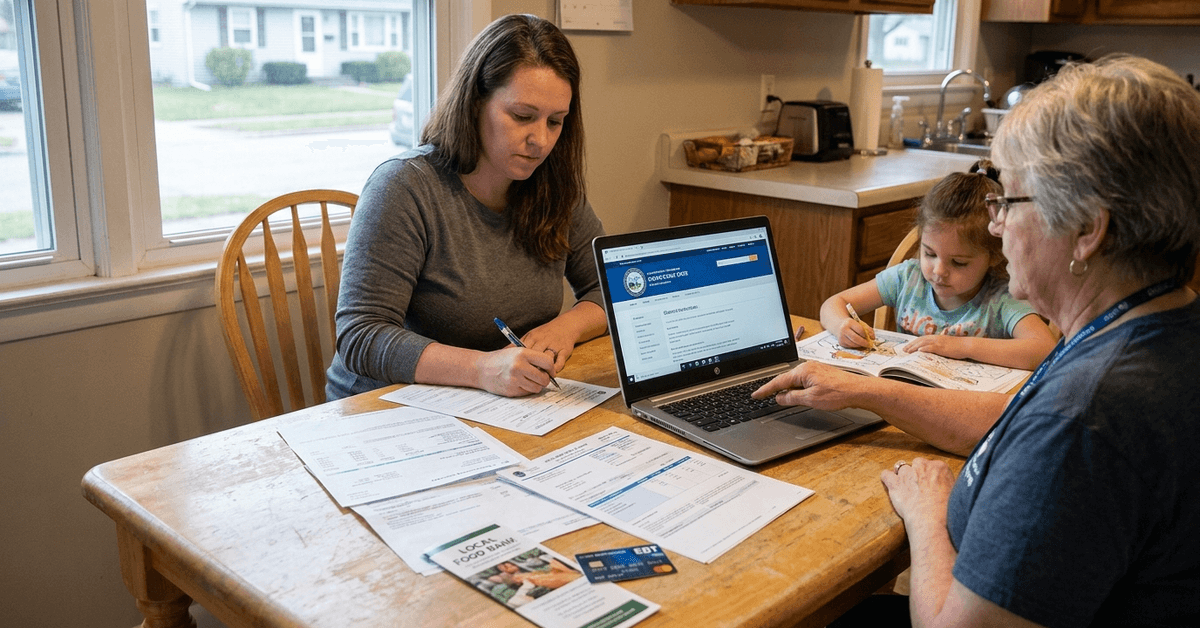
Net income accounts for deductions. SNAP allows a 20% earned income deduction, a standard deduction of $209 for households of one to three, plus deductions for shelter costs, dependent care, and medical expenses over $35 for elderly or disabled members.
The net income limit is 100% of FPL: $2,750 per month for a family of four.
The BBCE Expansion Most Applicants Miss
I think the single biggest blind spot in SNAP eligibility coverage is the BBCE income override. States like California, New York, and Florida have raised their gross income limits to 200% of FPL through this policy.
A household of four could clear $5,350 gross per month and still qualify for screening in those states.
The catch: the net income test at 100% FPL still applies everywhere. BBCE gets you past the first gate, not the second. But given how many people self-eliminate after seeing the federal gross threshold, this matters.
Elderly and disabled households get another break. If every member receives SSI or TANF, the gross income test may not apply at all. Only the net income test counts.
The SNAP Application Process, Step by Step
Every state runs its own SNAP office, so exact portal names and timelines shift depending on location. The federal structure underneath, though, is consistent. Five stages sit between starting the application and getting the EBT card loaded.
Gathering Documents
The paperwork step takes longer than the application itself. Pull these together before opening any form:
- State ID or driver's license for every adult applying
- Social Security numbers for each household member on the application
- Pay stubs, benefit statements, or self-employment records covering recent income
- A utility bill, lease, or rent receipt proving state residency
- Recent bank statements if your state enforces an asset limit (typically $3,000, or $4,500 for elderly/disabled households)
- Receipts for deductible expenses: rent, childcare, out-of-pocket medical costs
One common mistake: applicants list a roommate's income even when that person buys and prepares food separately.
SNAP defines a "household" by who shares meals, not who shares a lease. Getting this wrong inflates reported income and can trigger a denial.
Filling Out and Submitting the Application
Applications go through state portals, by mail, by phone, or in person. Online submission gives instant confirmation. Paper forms require keeping a photocopy. I would push back on the common advice to always apply online.
For a first-time applicant unfamiliar with SNAP terminology, an in-person or phone application at the local SNAP office listed in the USDA State Directory lets a caseworker flag missing documents on the spot. Online portals accept incomplete submissions without warning, and the denial letter arrives 30 days later without a clear fix.
A caseworker can catch a household composition error in five minutes. An online form cannot.
The Interview Nobody Should Skip
States require an eligibility interview, typically by phone. Miss it, and the application is automatically denied. This trips up more people than income limits do: roughly 1 in 5 SNAP denials trace back to missing paperwork or a missed interview, not ineligibility.
The interview lasts 10 to 20 minutes. A caseworker verifies submitted documents, asks about living arrangements, and flags anything unclear. If a document is missing, they may grant extra time to supply it. Bring the same paperwork stack to the call.
| Application Method | Confirmation Speed | Error Catch | Best For |
|---|---|---|---|
| Online portal | Instant receipt | None until review | Applicants comfortable with forms |
| Phone application | Same-day verbal | Caseworker flags issues live | First-time applicants |
| In-person office visit | Same-day verbal | Full document review on site | Complex households, elderly applicants |
Phone and in-person methods trade speed of submission for accuracy of submission.
The 2026 ABAWD Work Requirement Expansion
This is the rule change that quietly reshaped SNAP eligibility this year. The "One Big Beautiful Bill" passed in July 2025 expanded work requirements for Able-Bodied Adults Without Dependents (ABAWDs).
Who Counts as an ABAWD Now
The previous age range was 18 to 54. As of 2026, it covers 18 to 64. Adults between 55 and 64 without a qualifying exemption now fall under the rule for the first time.
The definition of "without dependents" also shifted. Parents whose youngest child is 14 or older now count as ABAWDs. Previously, having any child under 18 in the household exempted a parent.
Three groups that were previously exempt lost that protection entirely: veterans, youth who aged out of foster care, and individuals experiencing homelessness.
The 80-Hour Rule and the 3-Month Limit
ABAWDs must document 80 hours per month of work, job training, education, or approved volunteering. Falling short in any month triggers a countdown: SNAP benefits are limited to three months in a 36-month period for non-compliant ABAWDs.
Exemptions still exist for people receiving SSDI, SSI, workers' compensation, veterans' disability benefits, or unemployment insurance. Anyone in a TANF program meeting its own work rules is also covered.
"Good cause" exceptions apply for illness, transportation breakdowns, or emergencies, but these require documentation and a screening form.
After Approval: How the EBT Card Works
A decision letter arrives within 30 days of interview completion. Approved applicants receive an Electronic Benefit Transfer (EBT) card, which functions like a debit card restricted to food purchases. Benefits reload automatically each month.
What EBT Covers and What It Does Not
EBT covers groceries at most supermarkets and many smaller stores. It does not cover hot prepared food, alcohol, tobacco, vitamins, or household supplies.
Farmers' markets increasingly accept EBT, and some states run Double Up Food Bucks programs that match EBT spending on fruits and vegetables.
Monthly benefit amounts depend on household size and net income. A family of four with zero net income receives the maximum monthly allotment from USDA's benefit tables. As net income rises, the benefit decreases.
Reporting Changes and Recertification
Moving to a new state, gaining or losing a job, or adding a household member all require reporting within 10 days. Failing to report income changes can trigger overpayment collections later.
Recertification happens every 6 to 12 months depending on the state, and missing the deadline means restarting the full application.
Questions People Ask About Food Stamps Applications
These questions come up constantly in SNAP forums and search queries. Each answer adds a detail the main guide did not fully cover.
- Q: Can I apply for SNAP while working full time?
Absolutely. The 20% earned income deduction reduces countable income for working applicants. A single person earning $1,800 gross could deduct $360 before the net income test applies, potentially landing below the $1,383 net threshold. - Q: Does applying for food stamps affect immigration status?
SNAP is not considered a "public charge" benefit under current federal policy. Receiving food stamps does not create a negative mark for green card or citizenship applications. Eligibility categories for immigrants vary by state and visa type. - Q: How fast can I get emergency SNAP benefits?
Expedited SNAP is available for households with almost no income or resources. Approval can happen within 7 calendar days instead of the standard 30. Ask about expedited processing at the time of submission.
Conclusion
The 2026 SNAP landscape rewards applicants who check state-specific BBCE limits before assuming federal cutoffs apply. Expanded ABAWD rules mean adults up to age 64 need to document work hours or risk a three-month cap.
Filing in person or by phone catches errors that online portals silently accept. Pair the federal eligibility tables with a call to a local SNAP office for the most accurate picture of what benefits look like for a specific household.